
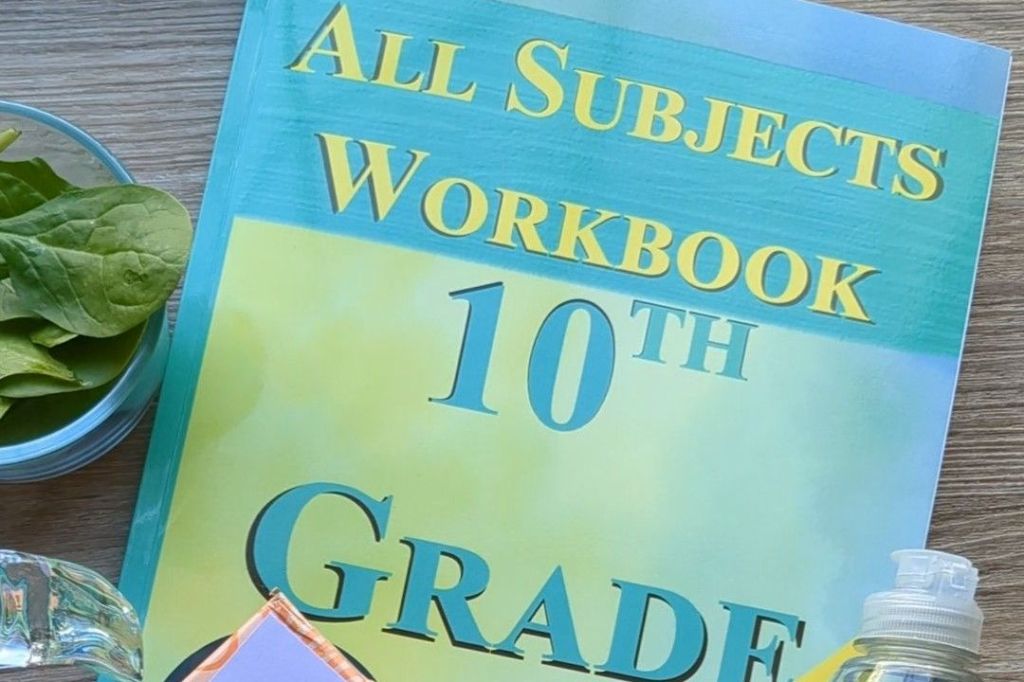
Photosynthesis, spinach, and a hole punch. It’s science.
If you are the proud owner of the Beyond Books Learning Resources 10th Grade All Subjects Workbook, then you will find this lab experiment in the science section! This post will help you help your student make the connections between the experiment observations and the real world implications.
Back to Photosynthesis. What is photosynthesis?
Photosynthesis is the process by which plants change light into food chemicals (glucose).
If you follow the procedures for this lab, you will see the experiment is to be carried out until half the disks float in at least one cup. But why? What is happening?
The Science of Photosynthesis
Plants need a few things to carry out the biological process we call Photosynthesis. They need sunlight, water, and carbon dioxide.
The plant has pigments that specialize in absorbing the sunlight which will be used in this process. The primary pigment used in photosynthesis is chlorophyll, which creates a green color in leaves. After the sunlight is absorbed and stored, the plant will use the stored energy to convert water and carbon dioxide into energy in the form of glucose. During this process, the ever-helpful oxygen is also produced. That’s a good enough reason to hug a tree, don’t you think?
This is a quick overview of photosynthesis. There is a lot going on inside the plant cells, but this is the general rundown of the science behind the way plants make their own energy. This process is very specific to plant cells, as animals cannot replicate this cycle.
The Experiment
This experiment compares two cups of different solutions. The first solution holds water with a drop of dish soap. The second holds the same with 1/4 teaspoon sodium bicarbonate (baking soda) added.
The next two important materials in this experiment are spinach leaves (in the form of hole-punched disks) and a light source such as a bright, sunny spot on a window sill.
The disks are placed into both cups. The student then must take observational notes until at least half the disks float in at least one cup. But why does this happen? And in which cup should you see it happen?
This is where your student should be doing some critical thinking.
So What’s the Answer?
The cup with the sodium bicarbonate should produce disks that begin to float after a few minutes. Why? Well, think about what is needed for photosynthesis. If the disks floating are a result of photosynthesis occurring, and sunlight and water were provided, what else must have been provided?
That’s right: carbon dioxide. Once the baking soda is dissolved into the water, it releases sodium hydroxide and carbonic acid which breaks down into … You got it! Carbon dioxide and water.
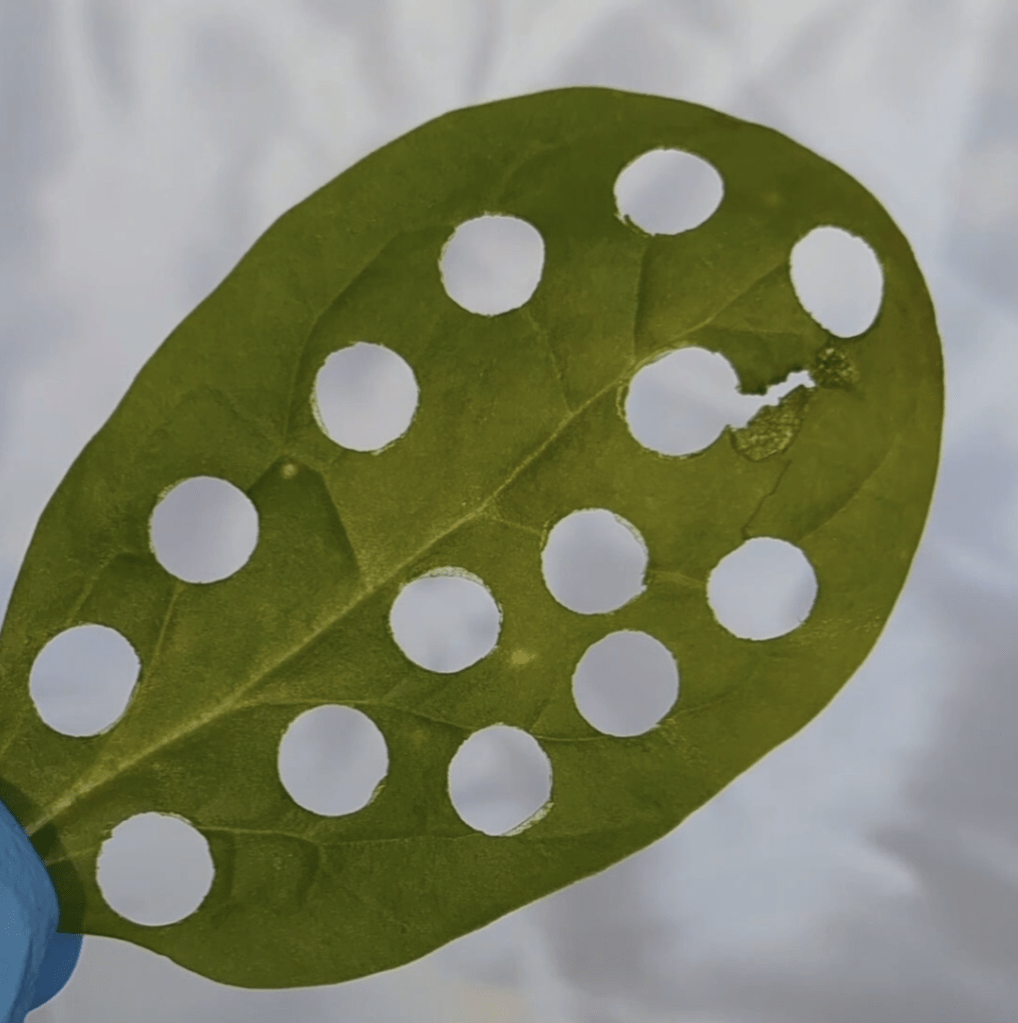
So the glass with sodium bicarbonate provided carbon dioxide, whereas the glass without it did not. In turn, the spinach disks were able to begin the process of photosynthesis in that cup. And what does photosynthesis produce?
Oxygen! The oxygen being produced caused the disks to rise to the top of the water. This allows us to see the evidence of the process of oxygen being produced!
Can you see the connection? When certain conditions are provided, life sustaining processes occur. We actually witnessed the spinach producing oxygen – something we couldn’t see with our own two eyes outside of the glass. Pretty neat!
Let your student think about ways the lab experiment could be improved. If your experiment didn’t have the same outcome, why?
Be sure to stay tuned for more experiments from this workbook and others in our series! Subscribe so you don’t miss out!
Thanks for stopping by for some science fun!
 Beyond Books Learning Resources
Leave a comment